
There is an instinct, present in almost anyone who takes their craft seriously, to want to learn from experience. Make a decision, observe the result, update accordingly. It is how surgeons get better, how athletes get better, how chess players get better, how most skills in life are built. Investing though is a poor fit for this instinct, and the eagerness to learn from one’s own past investments without first accepting that feedback loops in investing are weak, can do more harm than good.
Feedback is ambiguous and takes time to arrive
Michael Mauboussin wrote in his book The Success Equation “On the skill side of the continuum, feedback is clear and accurate, because there is a close relationship between cause and effect. Feedback on the luck side is often misleading because cause and effect are poorly correlated in the short run. Good decisions can lead to failure, and bad decisions can lead to success. Further, many of the activities that involve lots of luck have changing characteristics. The stock market is a great example. What worked in the past may not work in the future.”
In most skill-based pursuits, feedback is fast and clear. A surgeon knows within hours whether an operation succeeded. A chess player knows at the end of the game who won. An athlete knows immediately where he stood in a race. Investing does not work this way. A thesis can take years to play out, if it plays out at all in the time frame originally imagined. During that long interval, a stock price moves for dozens of reasons unrelated to whether the original analysis was sound. Examples include interest rate cycles, abrupt capital flows into a sector, or short-term industry tailwinds such as those experienced by IT services and chemical stocks during the pandemic. Broad risk-on or risk-off sentiment can also lift or sink everything indiscriminately.
Below is an extract from our Q4FY24 letter, The Ones That Got Away, where we wrote about stocks that became multibaggers after we sold them –
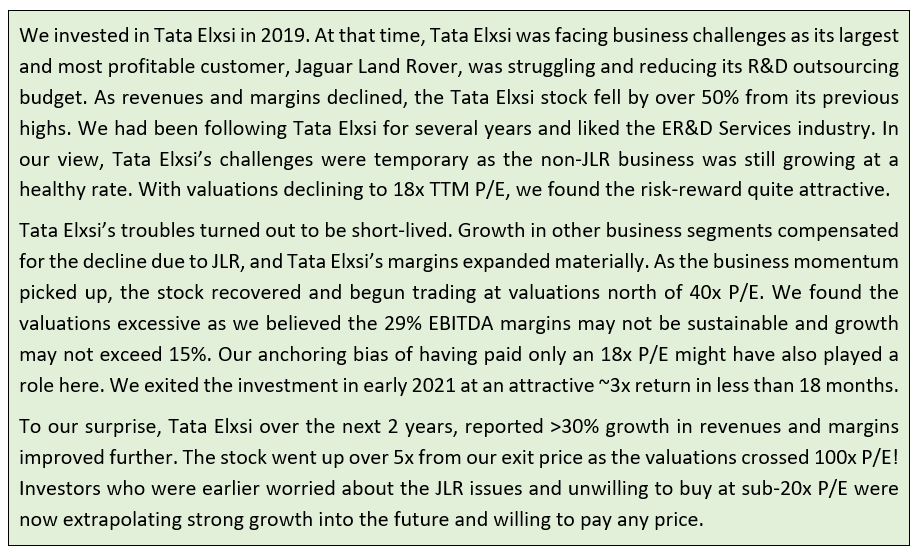
As “students of the markets” always willing to learn from our mistakes, what should have been the key lessons for us from this episode in 2022 after the stock went up 5x from our exit price in less than two years? Some lessons that come to mind are:
- ER&D budgets have been cyclical in the past but this time it is different; the high growth will sustain.
- When industry opportunity meets stellar execution, ignore valuation and ride the business momentum.
- Niche businesses deserve scarcity premium, especially if the growth runway is long.
What has happened since we wrote this letter is interesting. The stock is down more than 65% from its peak. The earnings growth over last 5 years has declined to 14% (like we had originally expected). The CAGR return of the stock since our exit is barely double digit and has trailed Nifty-500 returns. Maybe we were right all along.
Was there any learning at all to be taken from this experience? If yes, what was the right time frame to reflect on our investment? In 2022, 3 years after our investment? Or in 2026, 7 years after our investment. Based on when we did the reflection, the conclusions would have been poles apart as shown above.
There is no right answer except that most investment experiences are not necessarily learning experiences as many times feedback is ambiguous. If at all there are learnings, one must wait for a several years for the learning to become less ambiguous.
Even when feedback is clear, it may not be processed correctly
The problem is not simply that feedback is ambiguous and takes a long time to arrive. It is that once it does arrive, it is actively distorted by the way our minds process it. Daniel Kahneman called this problem “The Illusion of Understanding” in his book Thinking Fast and Slow. He identifies three related biases that together make it difficult for anyone, including investors, to interpret a past event accurately.
The first is the narrative fallacy. We’re always trying to make sense of the world, and the stories we find convincing tend to be simple ones that give too much credit to skill and too little to luck. In investing, this happens all the time. When a stock rises fivefold, we build a tidy story: great management, a growing industry, an obvious thesis. The role of timing, luck, or a rising market gets quietly forgotten.
The second is the halo effect: letting one good impression color everything else we think about a company or its leader. If a business has performed well for a few years, we start assuming it’s great at everything – culture, strategy, leadership.
The third is hindsight bias. Once we know the outcome, we judge decisions by how they turned out rather than by how sound they were at the time. We unconsciously rewrite our memory of how uncertain things really felt beforehand, so the result seems like it was obvious all along.
The practical consequence for an investor reviewing their own record is not great: the act of looking back is rarely an honest reconstruction of what was known and believed at the time. It is, more often, a flattering revision shaped by what has since happened. Sometimes the opposite too. An investor who made a thoughtful, well-reasoned decision that did not work out will often conclude that the decision was flawed because the bad outcome makes the original reasoning feel stupid in hindsight, even when it wasn’t.
MCX1 has been one of our most successful investments at 2Point2, yielding a 10x+ return since we first bought it in April 2020. However, its success had little to do with our original thesis.
We initially invested expecting a recovery in commodity futures volumes after a seven-year lull. Commodity volatility was rising, and we expected that operating leverage would drive disproportionate growth in profits. The Covid-crash had resulted in valuations reducing to near 20x trailing P/E which we found attractive.
Initially, both the business and the stock struggled to perform. Stringent SEBI margin rules (triggered by negative crude prices) caused crude Average Daily Trading Volume (ADTV) to crash by ~75%. Plagued by a messy tech migration, the stock barely moved for three years. MCX’s stock performance was in the bottom 5% of the top 1,000 stocks. Nevertheless, we continued to hold the stock as we believed that the stringent margin rules were not permanent in nature.
The regulator’s strict margins on futures had an unintended consequence though: liquidity migrated rapidly to options. Monitoring the business closely allowed us to notice this real-time shift. Drawing parallels to NSE’s options boom, we updated our thesis to focus on explosive options growth and chose to hold through the underperformance. MCX trading volumes further benefited from a post-Covid surge in retail trading and from unprecedented volatility in energy and bullion products aided by two wars. The eventual outcome: Q4 FY26 operating profits that are 4x of full-year FY20 profits and a 13x increase in stock price!
The revisionist, flattering assessment of our MCX investment is that we foresaw the options boom, the unprecedented geopolitical volatility, and the retail F&O wave. The honest version is that we didn’t anticipate any of these events, but because we stayed close to the business, we recognized the structural shift to options early enough to adapt our thesis. Any assessment that overlooks this evolution, or the role of luck, is simply incorrect.
Why learning from this kind of feedback can make you worse, not better
An eagerness to learn in spite of weak and ambiguous feedback loops becomes dangerous rather than simply unhelpful. An investor who treats every realized gain or loss as a clear lesson is, in effect, training on noise. If a position was sold and the stock subsequently rose, the eager learner concludes “I sell too early” and adjusts their behavior, perhaps holding longer next time, even when the next position genuinely should have been sold. If a position was sold and the stock subsequently fell, the eager learner concludes “my instinct was right” and grows more confident in a decision-making process that may have had little to do with the actual outcome. Both conclusions turn a single data point, contaminated by market noise and mental bias, into a flawed rule.
Should investors abandon reflecting on their Investments?
None of this is an argument for ignoring outcomes altogether, or for refusing to ever revisit past decisions. It is an argument for treating any single outcome with real suspicion before extracting a lesson from it, and for building a more deliberate and disciplined alternative to the natural instinct to learn quickly and confidently from whatever just happened.
The first discipline is separating process from outcome at the moment a decision is made, not after the fact. This means writing down the actual thesis at the time of making the investment, the conditions under which it would be proven wrong, and a realistic sense of the time horizon over which it is expected to play out rather than relying on memory. Only with this kind of record is it possible to later ask the right question, which is not “did this work?” but “did this play out the way I expected, for the reasons I expected, in the time frame I expected?”.
The second discipline is patience about sample size. A handful of positions, or even a year or two of results, is rarely enough to distinguish skill from luck in a probabilistic activity like investing. This argues for resisting the urge to overhaul a process based on a short run of good or bad outcomes, and for evaluating decision-making instead across a much larger number of trials, ideally encompassing different market regimes, before drawing firm conclusions.
The third discipline is a kind of deliberate slowness in drawing lessons at all. The natural instinct after a loss is to immediately extract a rule “never buy a company with that characteristic again,” “always sell when this kind of news breaks.” But a rule extracted from a single noisy data point, filtered through mental biases, is more likely to be a superstition than a genuine improvement. It is more useful to accept that some decisions will simply remain ambiguous for longer than we would like.
Investing is one of the few crafts where experience, if not handled carefully, can make you worse rather than better. The lesson from weak feedback loops is not to stop reflecting, but to reflect more slowly, more honestly, and with far less confidence in what a single outcome means. The investor who is comfortable sitting with ambiguity is, in the long run, better positioned than the one who is always certain they have learned something.
_______________________________________________________________________________________________________
1 We still have a small position in MCX